Shared AI Workspace for Business Communication
Relay Hub
2024
Overview
Designed an AI-powered workspace that enables teams to communicate, collaborate, and retrieve company knowledge within a shared environment. The system combines chat-based AI interaction, project collaboration, and internal knowledge access into a single, structured experience.
Roles and Responsibility
Product Designer
Team
Developers, Stakeholder, Testing
Timeline
4 Weeks
The Problem
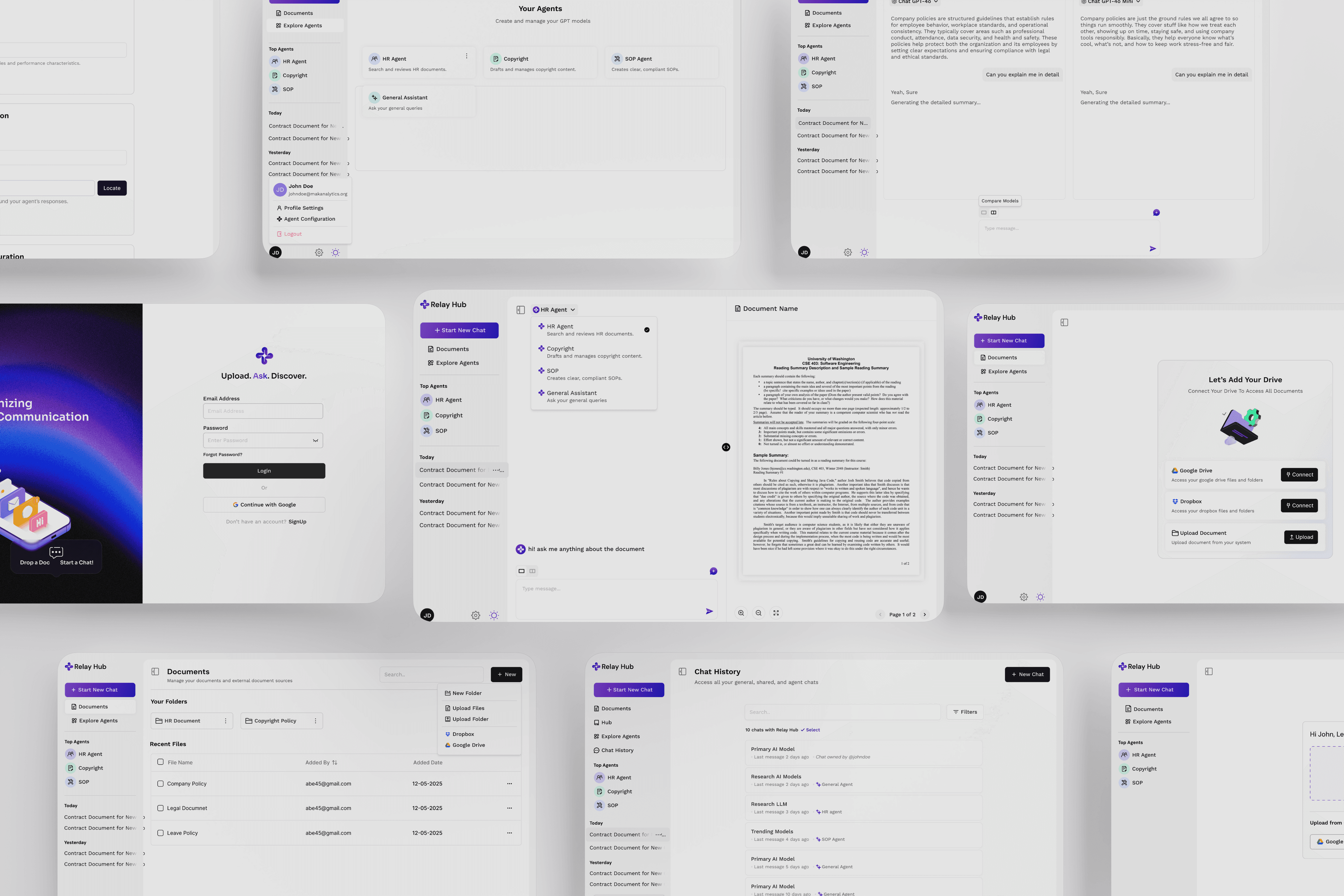
Companies manage communication, documents, and knowledge across multiple disconnected tools. Employees rely on emails, cloud storage, and individual AI tools to complete tasks, resulting in fragmented workflows and inefficiencies. While AI tools provide powerful capabilities, they are limited to individual use. There is no shared workspace where teams can collaborate, access company knowledge, and interact with AI in a structured way. This leads to: Scattered information across platforms Lack of collaborative AI workflows Repeated research and duplicated effort Security concerns with external AI usage
The Opportunity
Redesign how teams interact with AI by turning it into a shared workspace instead of an individual tool. The focus was to Combine communication, knowledge, and AI into one system Enable team collaboration within AI-driven workflows Provide access to both internal company data and external AI capabilities Ensure security through controlled access and permissions

Discovery
Initial Reserach
The initial research focused on understanding how teams currently use AI tools, collaboration platforms, and knowledge systems to manage their work. This involved analyzing how users interact with chat-based AI, how teams share and access information, and how workflows are distributed across tools like communication platforms and cloud storage. The goal was to identify gaps in usability, workflow continuity, and how effectively these systems support real-world collaboration.
While existing tools offer strong capabilities individually AI for quick insights, collaboration platforms for communication, and cloud systems for storage they operate in isolation. Users often switch between tools to complete a single task, leading to fragmented workflows, repeated effort, and limited context in AI interactions.
Observation: The core issue was not the lack of tools, but the lack of integration between AI, communication, and company knowledge within a shared workflow.
Competitive Analysis
To better understand how similar products approach AI interaction, collaboration, and knowledge management, I studied a range of existing tools and their core features. The focus was on how these systems structure user workflows, enable collaboration, and integrate AI within real-world use cases.
This analysis highlighted that while AI tools, collaboration platforms, and knowledge systems each solve specific parts of the problem, they operate independently. Users often switch between tools to complete a single task, leading to fragmented workflows and loss of context. Additionally, AI interactions are typically individual and not designed for shared, team-based usage.

Stakeholder Session
Following the initial kickoff, we conducted detailed discussions with stakeholders to understand the product vision, requirements, and scope. These sessions focused on aligning expectations around how the platform should function, what problems it should solve, and how AI, collaboration, and knowledge management should come together within a single system.
The conversations helped clarify key ideas such as enabling a shared AI workspace, integrating internal company data with external AI models, and supporting secure, role-based collaboration. Early inputs also highlighted the importance of simplicity, flexibility, and ensuring the system could adapt to different team workflows.
Sample Questions
How are teams currently using AI tools in their workflow?
What challenges do you face when accessing company knowledge?
How should collaboration work within AI interactions?
What level of control is required for internal vs external data?
How do you expect teams to share and reuse information?
What would make this system more valuable than existing tools?
Opportunity
This revealed a clear opportunity to design a unified system where AI, communication, and knowledge are integrated into a shared workspace. By bringing these elements together, the experience can support continuous workflows, enable collaborative AI usage, and provide contextual access to both internal and external information within a single environment.
What Got Shipped
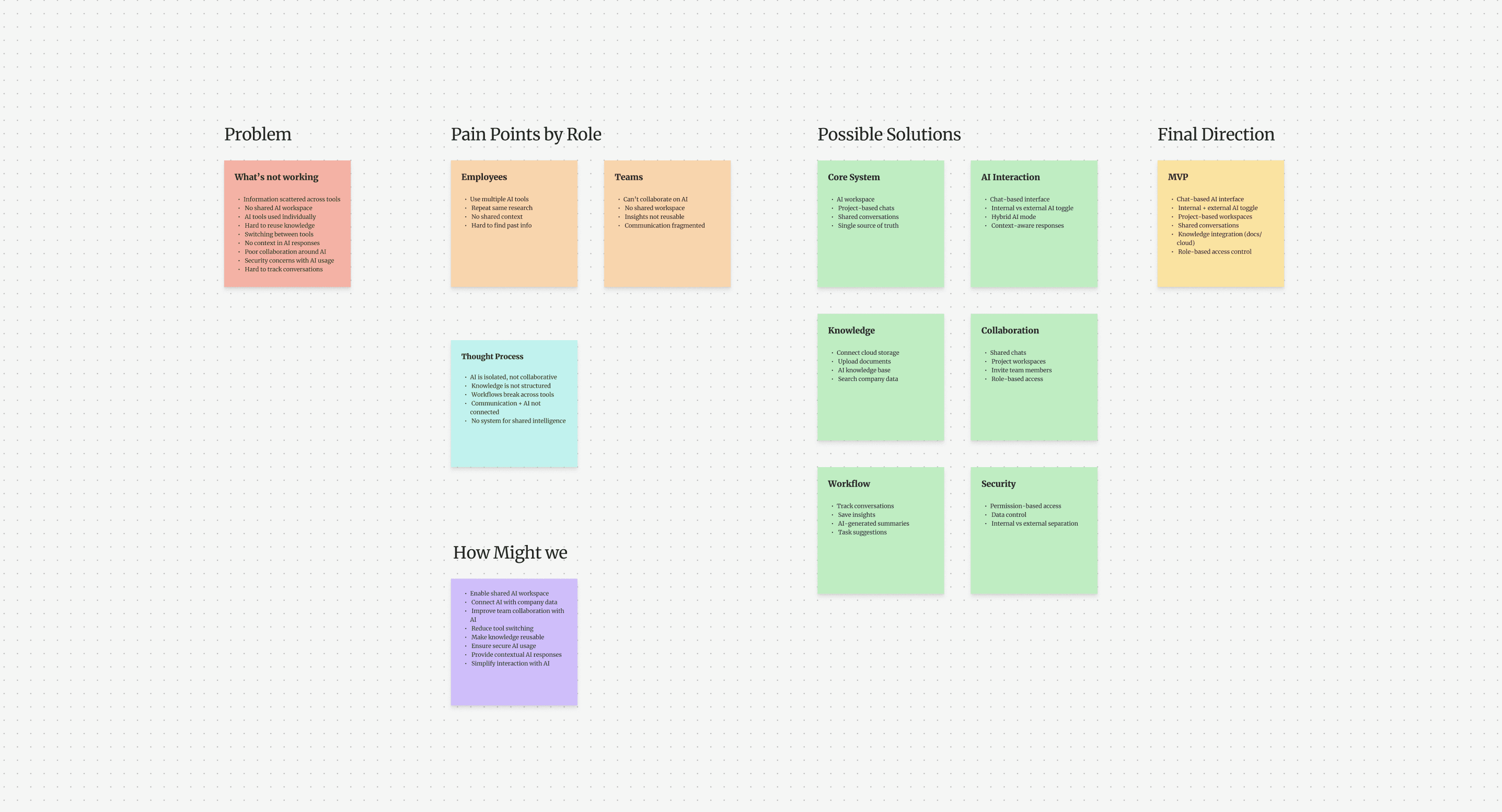
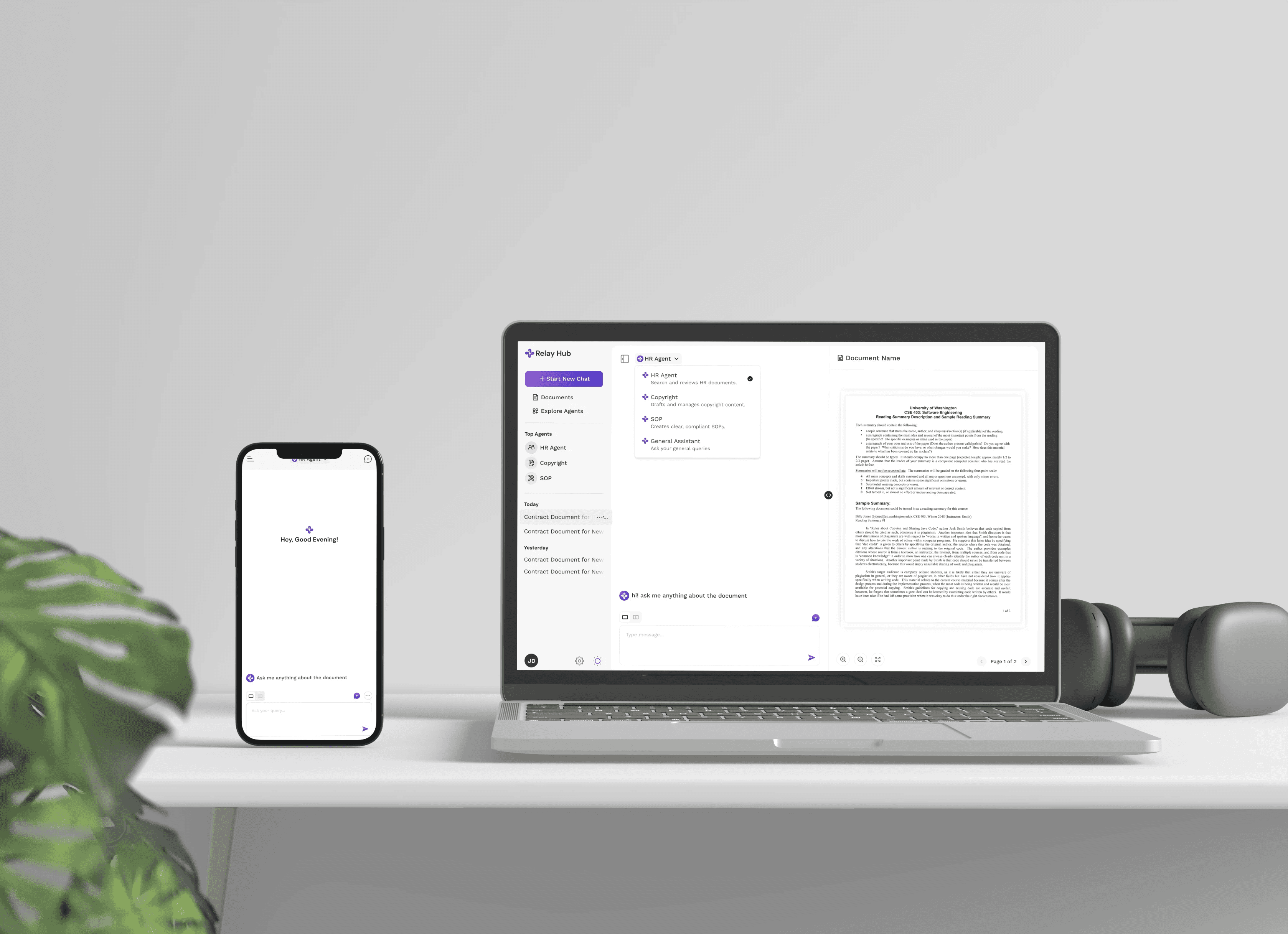
Designing a Familiar Chat-Based Interface
The core interaction is built around a chat interface similar to existing AI tools, reducing the learning curve and enabling quick adoption.
Users can interact with AI naturally while working within a structured environment.
Enabling Internal + External AI Modes
A toggle system allows users to switch between:
Internal knowledge mode (company data)
External AI mode (LLM-based responses)
Hybrid mode (combined)
This ensures flexibility while maintaining data security.

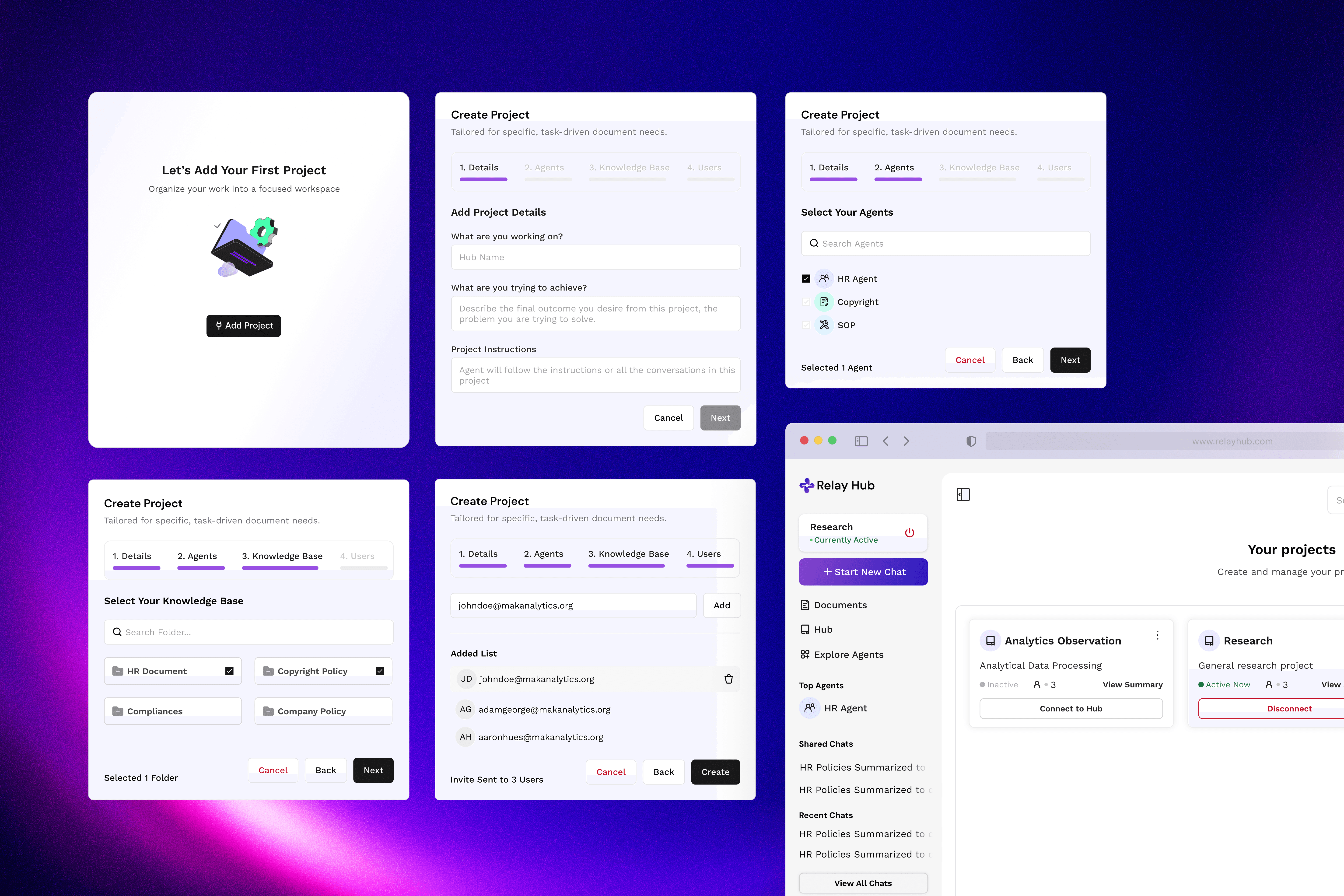
Creating Project-Based Workspaces
Instead of isolated chats, conversations are organized into projects, where teams can collaborate, share context, and build knowledge collectively.
This transforms AI from a personal tool into a team-driven workspace.

Designing for Collaboration and Access Control
Share chats and projects
Invite team members
Control access levels
This ensures secure collaboration while enabling knowledge sharing.
Impact
Operational Improvements
Reduced dependency on multiple tools
Improved efficiency in knowledge retrieval
Faster access to relevant information
Experience Improvements
Simplified interaction with AI
Enabled collaborative workflows
Reduced repeated research and effort
System Improvements
Centralized communication, knowledge, and AI
Introduced structured project-based workflows
Improved security with controlled access

 Resume